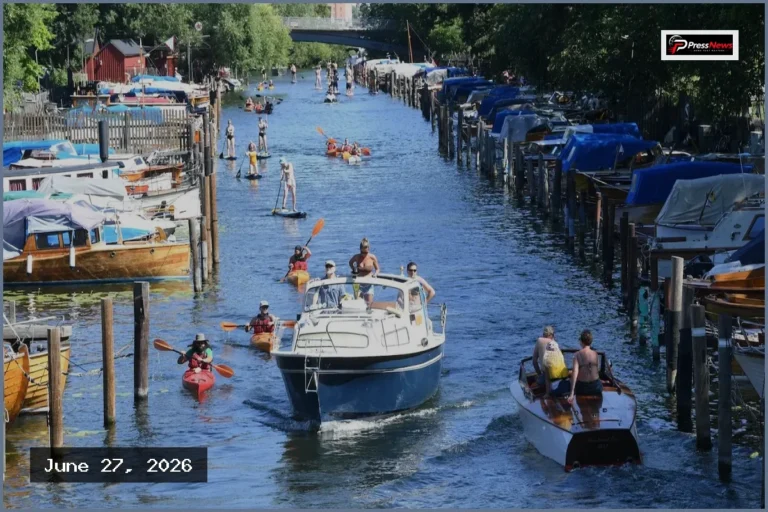

Europe’s ongoing heat wave is shifting eastward after breaking temperature records across several nations, though Germany still faces two more days of extreme heat. The current “heat dome” of trapped air originating from North Africa is forecast to migrate toward Central Europe and the Balkans. According to a new rapid study, this record-breaking weather event would have been virtually impossible to reach such extremes without the influence of human-induced climate change.
In Germany, the German Weather Service (DWD) has reported that the country’s highest-ever June temperature was reached on Friday in the western city of Saarbrücken, where preliminary data recorded 41.3 C (106.3 F). With temperatures expected to climb further, the DWD warns that some regions could hit 42 C (107.6 F) over the weekend. Saturday and Sunday are expected to see peak temperatures ranging from 39 to 41 C in eastern and southeastern regions, while the rest of the country will likely experience milder conditions between 32 and 38 C. Forecasters also cautioned that central and northern Germany may face thunderstorms, strong winds, and possible hail.
The extreme heat is pushing eastward, bringing respite to Western Europe as temperatures there return to typical summer norms. However, the World Meteorological Organization has confirmed that the Balkans and Central Europe will bear the brunt of the heat toward the end of the month. Both the Czech Republic and Hungary are currently on red alert, with forecasts predicting temperatures reaching 40 C. Hungarian Prime Minister Peter Magyar noted that millions of bags of drinking water are being prepared for potential distribution, though a Pride March in Budapest is still scheduled to proceed.
The United Kingdom also saw its hottest June day for the third day in a row, with Wattisham in Suffolk recording 36.9 C. The Met Office has extended an extreme heat warning for parts of England through Sunday morning. Meanwhile, event organizers across Europe are canceling or adjusting schedules to protect the public. The Defqon.1 festival in the Netherlands, which drew 50,000 attendees, was canceled after the country issued its first-ever nationwide code red alert. Similarly, events in Belgium and Paris have been called off or delayed, including the Paris Pride march, which is now postponed until September.
Health concerns remain a priority, as medical associations highlight a lack of air conditioning in many German hospitals. Susanne Johna of the Marburg Association noted that only about a third of hospitals have climate-controlled patient rooms, and she stressed that heat waves statistically lead to higher mortality rates. In France, Sports Minister Marina Ferrari urged citizens to use caution near water, reporting 55 swimming-related deaths since the heat wave began, with more than 65% of those incidents occurring at unsupervised or unauthorized locations. As climate change continues to intensify these weather patterns, experts emphasize that Europe is becoming the fastest-warming continent, making such deadly and frequent heat events a new, difficult reality for the region.