
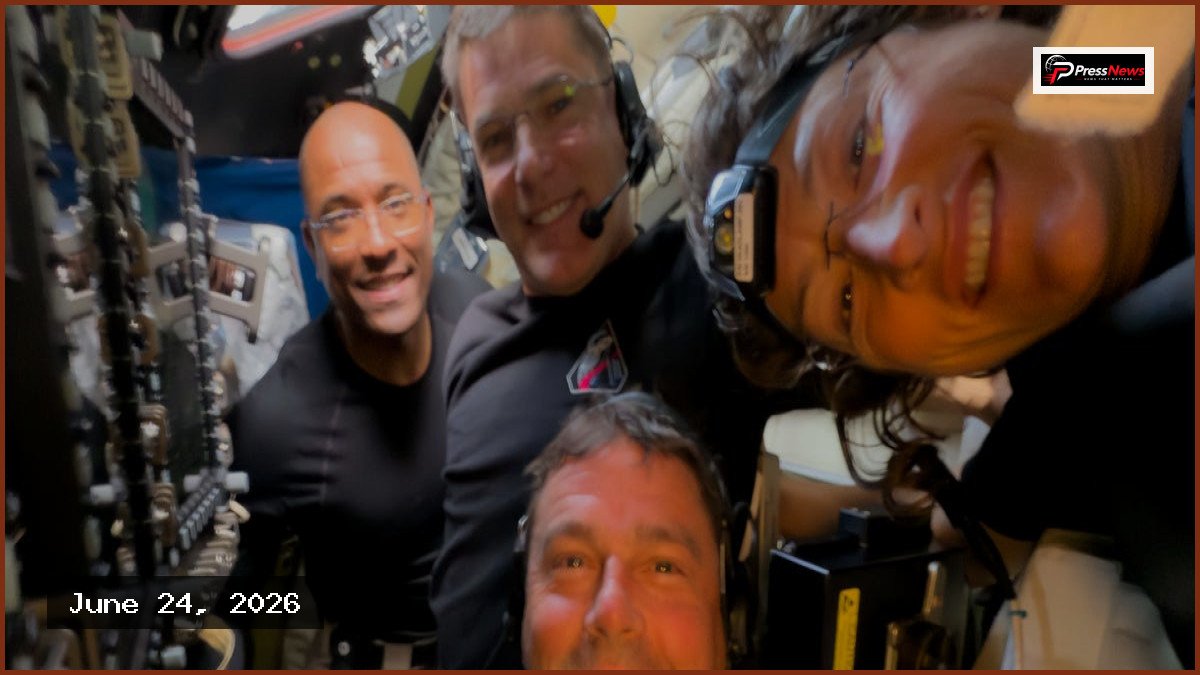
The four members of the Artemis II mission have already etched their names in history as the first astronauts in more than 50 years to navigate near the moon. Now, these explorers are in line to receive one of the nation’s most prestigious civilian honors. A new bipartisan legislative effort is underway to award the Artemis II crew a Congressional Gold Medal.
Senator Mark Kelly, a Democrat from Arizona and a former astronaut, is partnering with retiring Nebraska Republican Representative Don Bacon to introduce this legislation. The bills are set to be introduced in both the House and the Senate on Wednesday, June 24, as confirmed by Kelly’s office. Should the bill navigate the legislative process and be signed into law by President Donald Trump, it would mark the first time a crew of astronauts has received a Congressional Gold Medal since the honor was bestowed upon the Apollo 11 team in 2009, exactly 40 years after their historic 1969 mission.
This initiative follows the successful return of astronauts Reid Wiseman, Victor Glover, and Christina Koch, alongside the Canadian Space Agency’s Jeremy Hansen, who concluded their landmark mission more than two months ago. Lawmakers argue that the mission’s historical significance warrants this rare recognition. Senator Kelly, who was present at the launch in Florida, stated that the crew pushed human exploration further than ever before and inspired a new generation of engineers, scientists, and explorers. Representative Bacon commended the crew for extending the iconic legacy of the Apollo program, noting that they traveled further from Earth than any humans have ever dared to go.
The Congressional Gold Medal serves as the oldest and highest civilian honor provided by Congress. Established in 1776 when it was first presented to George Washington, the award has expanded over the centuries to include civilians and groups who have left a lasting impact on American history and culture. To date, the only other astronaut recipients were Neil Armstrong, Buzz Aldrin, and Michael Collins in 2009 for their role in the moon landing.
The Artemis II mission, a cornerstone of NASA’s multibillion-dollar program, utilized the 322-foot Space Launch System rocket and the Orion spacecraft for its April 1 departure from the Kennedy Space Center. Over a 10-day period, the astronauts orbited the moon, during which they surpassed the distance record established by the Apollo 13 crew in 1970 by reaching 252,756 miles from Earth. During their lunar flyby, they traveled within 4,067 miles of the surface and captured views of the moon’s far side never before seen by human eyes. The crew successfully splashed down in the Pacific Ocean near California on April 10.
Looking ahead, NASA is preparing for Artemis III in 2027, which intends to send a crew to Earth orbit to test systems for a future $20 billion moon base. This serves as a precursor to Artemis IV, targeted for 2028, which aims to be the first time humans set foot on the moon since the Apollo era concluded in 1972. Ultimately, these missions are designed as a vital stepping stone for the future of human exploration to Mars.