
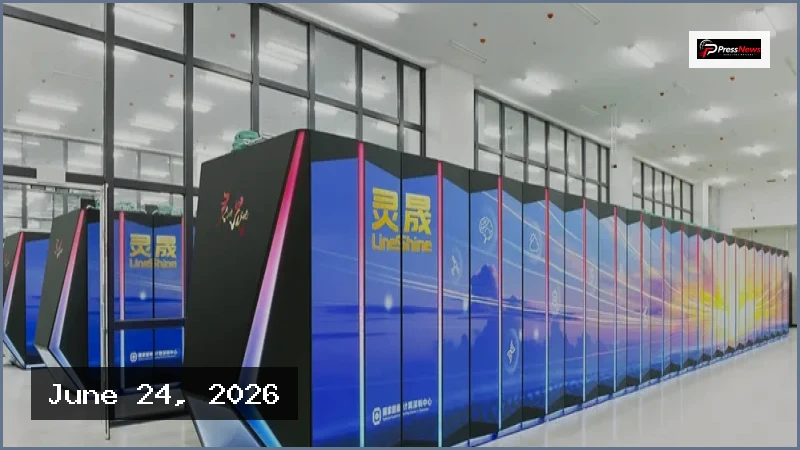
China has secured the number one position on the list of the world’s most powerful supercomputers, marking the first time since 2017 that it has surpassed the United States. The breakthrough comes as the two nations engage in a fierce race for technological supremacy, with the new machine relying on domestically produced chips.
Known as the LineShine, the supercomputer is located at the National Supercomputing Center in Shenzhen, a major Chinese technology hub. It has officially unseated the previous American leader, El Capitan, according to the most recent biannual TOP500 ranking. The report, released on Tuesday, indicates that the LineShine operates with a computing speed approximately 20% faster than El Capitan, which is situated at the Lawrence Livermore National Laboratory in California.
Supercomputers are specialized systems built for high-speed, complex calculations, often utilized for weather forecasting, training artificial intelligence models, conducting scientific simulations, and developing new pharmaceutical drugs. The rise of the LineShine occurs against a backdrop of escalating tech rivalries, as Washington continues efforts to restrict Beijing’s access to critical frontier technologies, including semiconductors and AI hardware.
Since the first term of President Donald Trump, the US has implemented various export controls and restrictions to impede China’s progress in these fields. In an official statement, China’s National Supercomputing Center credited the LineShine to the successful navigation of several core technological bottlenecks. They described the achievement as a historic step for the nation in overcoming foreign restrictions and establishing an independently managed software and hardware ecosystem.
A significant detail regarding the LineShine is its reliance entirely on conventional CPUs rather than the specialized GPUs that dominate the current global supercomputing market and are provided by US firms such as Nvidia. Following various trade measures in 2022 that limited China’s access to high-end GPUs, Chinese companies have been forced to innovate around these limitations. This was previously observed when the AI startup DeepSeek delivered high-level performance using fewer advanced chips, catching much of the industry by surprise.
Lu Yutong, the chief designer of the LineShine, noted during the TOP500 awards ceremony in Hamburg, Germany, that the machine successfully broke away from the standard hybrid architecture that combines CPUs and GPUs. According to the National Supercomputing Center, the system utilizes a fully domestic, full-stack computing infrastructure—including CPUs and high-bandwidth memory—to handle diverse engineering, scientific, and AI workloads. Since its deployment, the machine has been applied to fields ranging from neuroscience and drug discovery to climate modeling.
Despite the significance of the ranking, experts advise against using it as a definitive measure of a country’s broader AI capabilities. Andrew Rohl, director at the National Computational Infrastructure in Australia, remarked that while it is an impressive technical feat, the TOP500 is not a relevant metric for determining the quality of infrastructure available for AI development, as the benchmark was designed for traditional scientific workloads. Furthermore, many of the most advanced AI systems developed by US tech corporations or defense facilities are not included in the ranking due to economic or security sensitivities.
Following the top-ranked LineShine and second-place El Capitan, the remainder of the list features American machines located in national laboratories in Illinois and Tennessee, as well as a high-performing system in Germany. Other nations, including Japan, Switzerland, and Italy, also maintain rankings within the top ten.


