
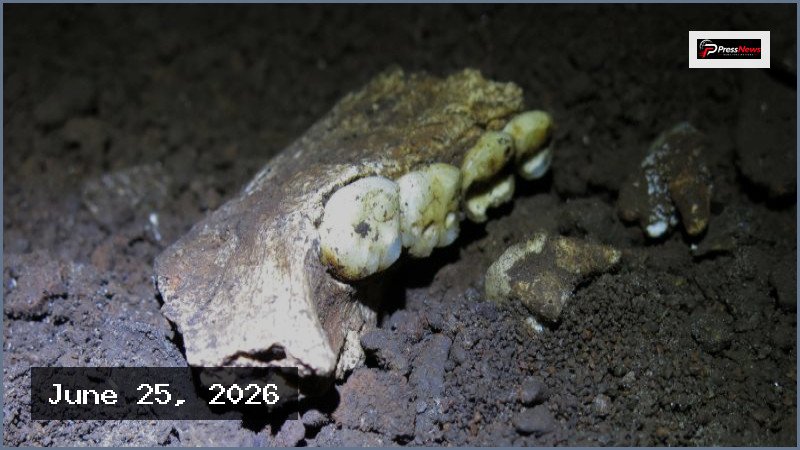
Humanlike fossils discovered within the intricate and deep tunnels of South Africa’s Rising Star cave system have significantly altered scientific understanding of human origins over the last decade. Recent investigations into the biological sex of these remains have introduced a perplexing new chapter regarding this unique human relative.
Scientists first described the small-bodied hominin species in 2015, following the discovery of a dense fossil cache in the cave’s Dinaledi Chamber. Despite the species possessing a brain size comparable to that of a chimpanzee, researchers had previously hypothesized that Homo naledi engaged in sophisticated behaviors such as the deliberate burial of their dead and the potential engraving of symbols on cave walls.
The latest study, published in the journal Cell, adds a layer of mystery to these findings. By extracting ancient proteins from tooth enamel, researchers determined that 20 individuals found at the site were all female. Lee Berger, a paleoanthropologist and National Geographic explorer in residence who led the excavations, noted that the results were unexpected and prompted the team to verify the data through two separate laboratories to rule out internal errors.
The research was spearheaded by molecular scientist Palesa Madupe, currently a postdoctoral researcher at the Max Planck Institute for Evolutionary Anthropology, while she was at the University of Copenhagen. Madupe analyzed 23 samples of tooth enamel, with 20 yielding usable information. The team searched for the male-specific amelogenin protein, which is linked to the Y chromosome, but found it absent in every sample.
The remains, which date back between 335,000 and 241,000 years, displayed little physical variation between individuals. Berger admitted that, in hindsight, the lack of sexual dimorphism—the physical differences between males and females—should have been more apparent when the species was first described in 2015. He suggests this discovery points to sex-based bias in mortuary practices, implying that Homo naledi may have separated individuals by gender in death.
However, the research team also considered the possibility that the male amelogenin gene may have been mutated or deleted. Enrico Cappellini, a professor of paleoproteomics at the University of Copenhagen, stated that while gene deletion has been observed in some modern humans and Neanderthals, it remains highly unlikely that this would occur consistently across half of the 20 individuals studied. Both the possibility of sex-segregated burial and systematic gene deletion present major implications for understanding the evolution of the species.
Independent experts offer alternative interpretations. Michael Petraglia of Griffith University questioned the burial theory, suggesting that the female-only result might mirror foraging behaviors seen in chimpanzees, where groups of females and their offspring cluster in sheltered areas. Berger countered this by noting that if the groups were simply foraging, he would expect to see juvenile males among the remains, yet none have been identified. While the scientific community debates the findings, researchers agree that the Rising Star site continues to challenge established narratives about the cognitive abilities and social lives of our early human relatives.


