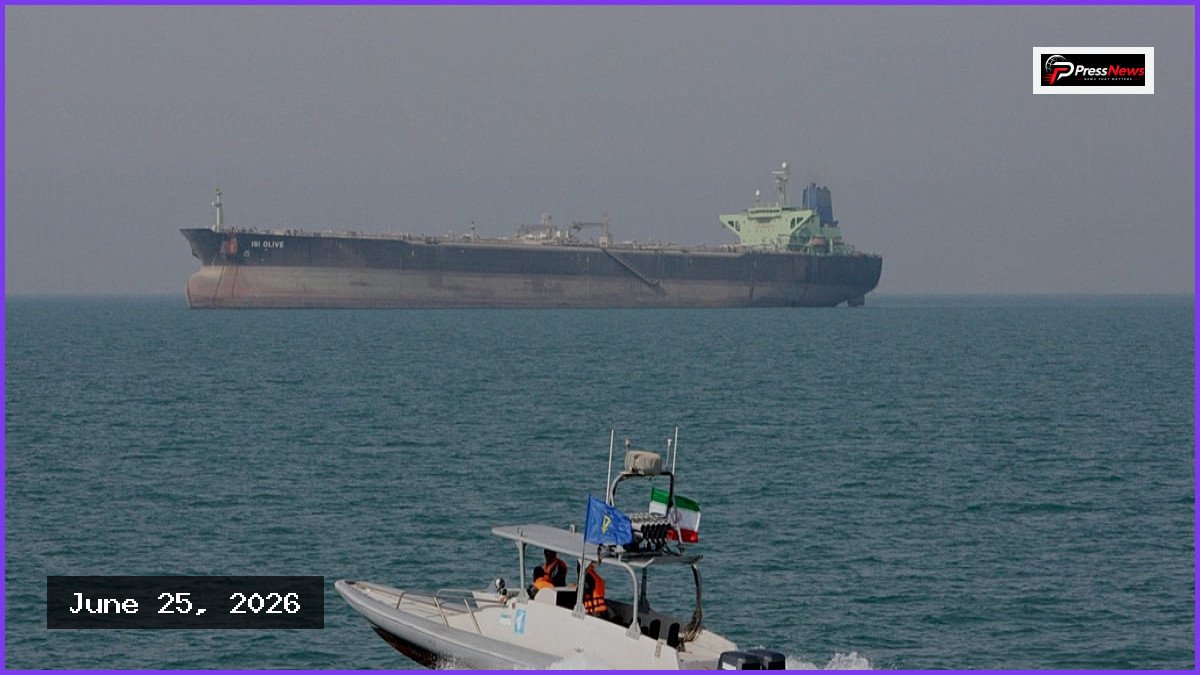
Iran’s Islamic Revolutionary Guard Corps (IRGC) issued a stern warning on Thursday, declaring that all maritime vessels traveling through the Strait of Hormuz must adhere exclusively to routes designated by Tehran. The military body stated that any ship operating outside of these specific parameters would be considered illegal. This declaration serves as a direct challenge to a recent announcement by Oman, which had proposed a new temporary maritime corridor positioned near its own coastline.
In an official statement, the IRGC asserted that the only authorized navigation paths are those established by the Islamic Republic of Iran, labeling any alternative routes as highly dangerous and strictly prohibited. The IRGC specifically criticized a recently proposed route—matching Oman’s initiative—as being completely unacceptable and dangerous, noting it was established without any prior coordination with Iran. The organization vowed to take action against violators without providing further details on the nature of these consequences.
Reports from IRGC-affiliated media suggested that three oil tankers navigating Oman’s southern corridor were forced to turn back into the Persian Gulf following warnings from the IRGC Navy. However, South Korea’s Oceans Ministry reported that five of its operated vessels managed to transit the strait successfully on Thursday, suggesting that movement remains possible. Benyamin Saeedi, secretary of Iran’s parliamentary National Security Commission, emphasized that control of the waterway rests firmly with Iranian military forces and cautioned that any miscalculation in the region would trigger a decisive response.
Saeedi added that Tehran expects the United States to fulfill its obligations under the current framework deal, specifically regarding the release of frozen assets and the removal of maritime restrictions. Internal political pressure from Iranian hardliners persists, bolstered by a message attributed to Ayatollah Mojtaba Khamenei, which argued against relinquishing leverage over the strait despite his conditional approval of the agreement.
Meanwhile, US Secretary of State Marco Rubio addressed the situation at a GCC ministerial meeting in Bahrain, stating clearly that Washington would not tolerate the imposition of any fees or tolls for transit. Rubio dismissed arguments regarding potential fees as merely semantic, asserting that because no single country owns the Strait of Hormuz, no nation possesses the legal authority to charge for its passage. He further clarified that the current diplomatic deal does not undermine the prosperity or security of Gulf partners.
Omani Foreign Minister Sayyid Badr Al Busaidi confirmed at the same gathering that Muscat maintains a responsibility as a coastal state to uphold international law and UNCLOS. He explicitly stated that future arrangements for the strait would not include the implementation of transit fees. This follows comments from Donald Trump on Wednesday, where he noted that Iran had provided assurances against imposing such fees, warning that negotiations would cease immediately if those claims were proven false.
Despite the conflicting rhetoric, shipping data from the International Maritime Organisation indicates a gradual normalization of traffic. On Tuesday, 13 vessels transited the area, followed by 32 on Wednesday and 12 by Thursday morning, as part of a UN-coordinated evacuation effort. Marine data firm Kpler recorded 70 passages on Wednesday, reaching the highest volume since March 1, though figures remain below the pre-war daily average of 130. Industry experts, including Richard Meade of Lloyd’s List, noted that many operators are now attempting to clear the backlog of cargo that accumulated during the conflict as transit risks appear to decline. Consequently, oil markets have continued to see prices ease, with Brent crude reaching its lowest point since February 27.