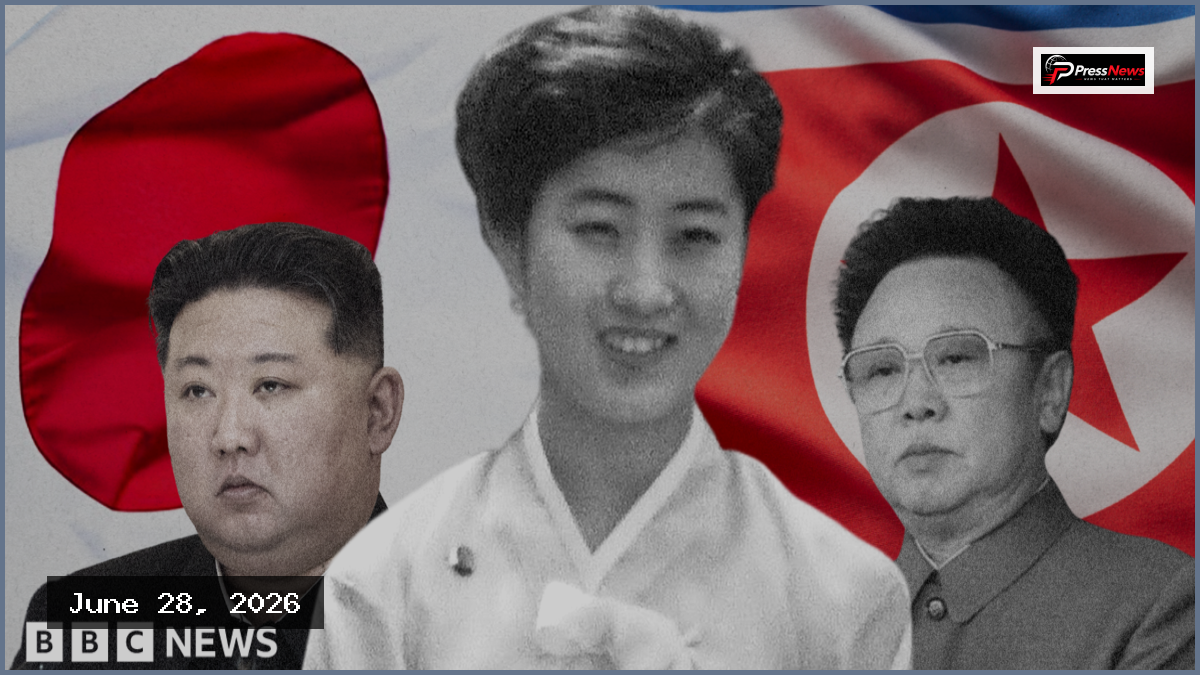
Among the many closely guarded aspects of North Korean leader Kim Jong Un’s life, the profound secrecy surrounding his mother, Ko Yong Hui, is particularly notable. Throughout his 15 years in power, Kim has consistently refrained from publicly mentioning her by name.
The foundation of Kim’s authoritarian rule heavily relies on the revered ‘Mount Paektu’ bloodline, a lineage deeply connected to the mythical founder of the Korean people. In a nation that places immense value on this hereditary purity, the true identity of Kim’s mother is not merely a secret but a potential destabilizing force for the regime itself.
State media in North Korea has likewise never acknowledged Ko Yong Hui.
Popular belief dictates that the history of the Koreas originated on Mount Paektu, a mountain situated on the China-North Korea border, believed to be the birthplace of Dangun, the legendary founder of Korea’s first kingdom. Centuries later, Kim Il Sung, the founder of North Korea, reportedly utilized this mountain as a sanctuary during his fight against the Japanese. His son, Kim Jong Il, was also said to have been born on these sacred slopes, despite indications suggesting his birth likely occurred in Russia. For decades, the mountain has served as a crucial symbol to legitimize the Kim dynasty.
Ryu Hyun-woo, an exiled North Korean diplomat, noted in his book, Kim Jong Un’s Secret Vault, that Kim Jong Un ascended to heir in his twenties, despite lacking significant achievements, solely due to his connection to the Paektu bloodline.
However, the reality of Kim’s maternal ancestry presents a starkly different narrative. Hundreds of miles from Mount Paektu lies Osaka, Japan’s historic capital, where Ko Yong Hui was reportedly born in 1952. Biographers have pieced together that her parents were originally from Jeju Island, located off the southern coast of what is now South Korea.
As residents of Japan, Ko’s family were classified as ‘Zainichi Koreans,’ a term for immigrants who arrived during Japan’s colonial rule of the Korean peninsula from 1910 to 1945. Around the age of 10, Ko’s family relocated to North Korea. They were among an estimated 93,000 Koreans who migrated to the North between 1959 and 1984, enticed by a resettlement program that promised an ideal life with free healthcare, education, and employment.
Initially, these migrants were viewed with envy, bringing cash, clothing, and home appliances from the capitalist South. Yet, they were also disparagingly labeled ‘jjaepo,’ a term for a group considered tainted by foreign, dangerous ideologies. North Korean society operates on a rigid hierarchical structure, often likened to a caste system by analysts. Within this strict social classification, known as ‘songbun,’ the ‘jjaepo’ occupy the ‘wavering class,’ positioned between the core and hostile classes. They face extensive state surveillance and are frequently denied access to prestigious universities or promising career opportunities.
This background stands in stark contrast to the Paektu narrative consistently promoted by Kim’s family. Kim Hyung-su of the Northern Research Association emphasizes that the regime’s Paektu bloodline is considered sacred, making the notion of the leader being a ‘jjaepo’s son unimaginable.
Ko Yong Hui, however, managed to circumvent the typical fate of her fellow Zainichi Koreans after she captured the attention of Kim Jong Il, who was already being prepared for succession. Intelligence reports indicate that Kim Jong Il was officially married to Kim Young Sook, the daughter of a high-ranking military official, in a union arranged by his father. He was also known to have two other mistresses.
Despite these circumstances, Ko, a member of the elite Mansudae Art Troupe, reportedly drew Kim’s interest due to her ‘natural beauty and dancing skills,’ according to Yoji Gomi, a Japanese reporter who authored a book on Ko in 2025. Reports suggest Kim Jong Il developed a passionate love for Ko, and they went on to have three children together.
However, children born out of wedlock face severe social stigma in North Korea. Consequently, while Kim’s official wife resided in the capital Pyongyang, Ko and her children were kept 210km (130 mi) away in the coastal town of Wonsan. Although she never formally married the supreme leader, and their relationship was not officially recognized by the regime, Ko reportedly lived what Gomi describes as a ‘Cinderella-like life.’
Ryu noted that Ko was ‘never recognised as a daughter-in-law by Kim Il Sung,’ nor was Kim Il Sung ever publicly seen with her children. Dr. Cheong Seong-chang of the Sejong Institute suggests that had Ko received Kim Il Sung’s approval, photographs of him and his grandchildren would have been widely disseminated.
Following Kim Il Sung’s death, Kim Jong Il assumed the role of North Korea’s supreme leader, and Ko effectively became the country’s de-facto first lady, accompanying her husband on military inspections and cultivating friendships within his inner circle. Fujimoto, Kim’s former chef, even wrote that Kim would consult Ko for her opinion before making policy decisions.
An official documentary produced in 2011 featured footage of Ko accompanying Kim on local tours, though it deliberately omitted her name and ‘songbun.’ This documentary was never publicly released, instead being shown only to senior party officials in June 2012, as stated by Dr. Cheong. It was later leaked and circulated among ordinary citizens via smuggled USB drives. Dr. Cheong explains that as the documentary spread, public curiosity about Ko Yong Hui surged, prompting the regime to swiftly recall it, as her background could potentially undermine the regime’s legitimacy.
In 2004, Ko passed away from breast cancer at a hospital in Paris. Her death went entirely unmentioned by North Korean state media.
The question then arises: How did a mistress’s second son, and Kim Jong Il’s youngest, ultimately inherit power? Kim Young Sook, Kim’s official wife, bore two daughters, neither of whom were eligible for succession. Kim Jong Il also had two other mistresses besides Ko: Sung Hae-rim and Kim Ok. While Kim Ok had no children, for a period, it seemed that Kim’s firstborn son with Sung Hae-rim, Kim Jong Nam, might have been considered.
However, Kim Jong Nam, who studied abroad for over a decade and was fluent in English and French, fell out of favor early on. He openly questioned North Korea’s hereditary succession and advocated for reform, according to Gomi, who corresponded with him for years. He also gained a reputation as a partier due due to his frequent casino visits and lavish lifestyle. In 2017, after several years of exile in Macau, Kim Jong Nam was assassinated in Malaysia with a lethal nerve agent.
Kim Jong Un’s older brother, Kim Jong Chul, was also ruled out as an heir due to a severe opium addiction, as reported by ex-diplomat Ryu. Consequently, Ko is believed to have actively championed her second son, Kim Jong Un, for succession. This decision was reportedly influenced by Ko’s sister, who advised that her son must become the next leader to safeguard their family, as detailed by journalist Anna Fifield in her book, The Great Successor: The Secret Rise and Rule of Kim Jong Un.
Analysts suggest that Kim Jong Un quickly became his father’s favorite, largely owing to his leadership potential and competitive nature. Although he also briefly studied overseas in Switzerland, he was reportedly far more insulated than his half-brother, Kim Jong Nam. Thus, when Kim Jong Il died in 2011, Kim Jong Un, then 27, secured his position on the throne.
Since then, Kim has entrusted significant power to his sister, Kim Yo Jong, who is believed to lead the influential propaganda department, according to South Korea’s Unification Ministry.
Despite his position, the question of Kim’s parentage continues to cast a shadow over the supreme leader. Analysts believe this is why his birthday has not been declared a national holiday, unlike those of his grandfather and father. Drawing attention to his birth could raise uncomfortable questions about his mother and why he was not raised in Pyongyang.
The secrecy surrounding his parentage may also explain his swift public presentation of his wife, Ri Sol Ju. Unlike his mother, Ri is believed to hail from an upper-middle-class family in Pyongyang, according to South Korea’s intelligence service. A former singer in a prestigious performance group, she also studied classical singing in China during her youth, an indicator of good ‘songbun.’
Gomi suggests that the ‘sense of illegitimacy and resentment’ Kim Jong Un experienced due to his mother’s background paradoxically became a powerful impetus for him to publicly introduce his wife, Ri Sol Ju, and daughter, Ju Ae, at an early stage. These public displays, Gomi adds, may stem from a ‘perceived ‘deficiency” related to his mother’s origins.
Should the origins of Kim’s mother ever become public knowledge, Ryu warns that it would not only undermine his legitimacy but also destabilize the hereditary system at its very core. He states it would have ‘the impact of a nuclear bomb on North Korean society.’