
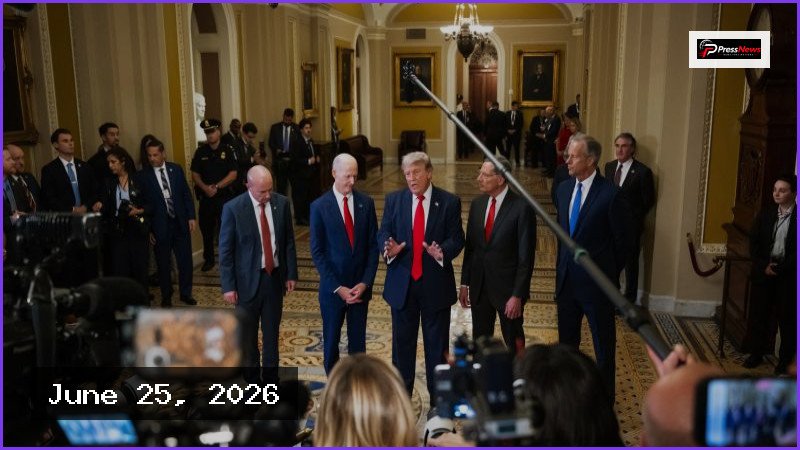
A single day after passing a resolution seeking the removal of United States military personnel from the conflict involving Iran, the Senate pivoted away from its rebuke of President Donald Trump’s war management. During a late-night session on Wednesday, the chamber blocked a follow-up attempt to move forward with a nearly identical war powers measure.
This outcome followed open frustration from President Trump toward Senate Republicans who supported Tuesday’s initial Iran war powers resolution, as well as those who failed to participate in the vote. The president maintained that congressional action significantly hampered his authority during high-stakes negotiations with Iran.
Voting patterns shifted noticeably among two GOP senators who had previously backed constraints on presidential authority. Kentucky Senator Rand Paul moved to a “present” vote, while Louisiana Senator Bill Cassidy voted against advancing the resolution. Meanwhile, GOP Senators Susan Collins and Lisa Murkowski held firm in their support for the measure, and Democratic Senator John Fetterman stood by his previous opposition. The final vote count concluded at 47-50-1.
President Trump praised the result via Truth Social, highlighting the shifts from Paul and Cassidy and declaring, “This vote puts Iran on notice!”
Earlier on Wednesday, Senator Cassidy participated in a high-tension lunch with Senate Republicans where he challenged the president directly. Cassidy told reporters afterward that he had pushed Trump for more transparency, stating, “You have not told the American people what’s going on. It was supposed to last four weeks, it’s lasted four months. Our original objectives have not been achieved, and I want to know what’s going on.” However, following a “thorough briefing” later that afternoon from Vice President JD Vance and special envoy Steve Witkoff, Cassidy expressed his appreciation on X for the “quick invitation to the White House” and the detailed information provided.
Senator Paul also addressed his pivot on X, clarifying that his position on executive power remained unchanged but that he was yielding to the president’s request for flexibility in negotiations. Paul wrote, “Since hostilities seem to be over and the President asked me to give consideration to his negotiating position, I will do so. My vote of present is a way to give the President more space and leverage to negotiate a lasting peace.”
During the meeting on Capitol Hill, Trump also criticized GOP Senators Dave McCormick and Mitch McConnell for their absences during Tuesday’s vote. In reality, McConnell was hospitalized at the time, and McCormick was traveling aboard Air Force One with the president for an event in Pennsylvania.
Wednesday’s vote was the 11th time this year the Senate has addressed an Iran war powers resolution. The measure had been discharged from committee last month during a period of Republican absences, and Democrats were attempting to build momentum for a successful floor vote. Republicans, however, brought the measure to the floor Wednesday night in an attempt to defeat it.
Trump has consistently attacked any Republicans supporting such measures. Earlier this month, when the House passed a concurrent resolution by a vote of 215 to 208, with four House Republicans crossing party lines, Trump labeled the defectors “GRANDSTANDERS” and called their vote “unpatriotic.” After the Senate adopted its concurrent resolution on Tuesday in a 50-48 vote, Trump called the four supporting GOP senators “losers,” stating that they had made his diplomatic efforts significantly more difficult.
Despite the administration reaching a preliminary agreement with Iran, some Democrats remain concerned. Senator Tim Kaine of Virginia argued last week that formal congressional oversight is essential, telling reporters, “I think it’s a good time to have the vote to say, ‘Hey, if we’re really in a period of maybe some stability here, let’s not just allow it to start up again without Congress being involved in that decision.’”