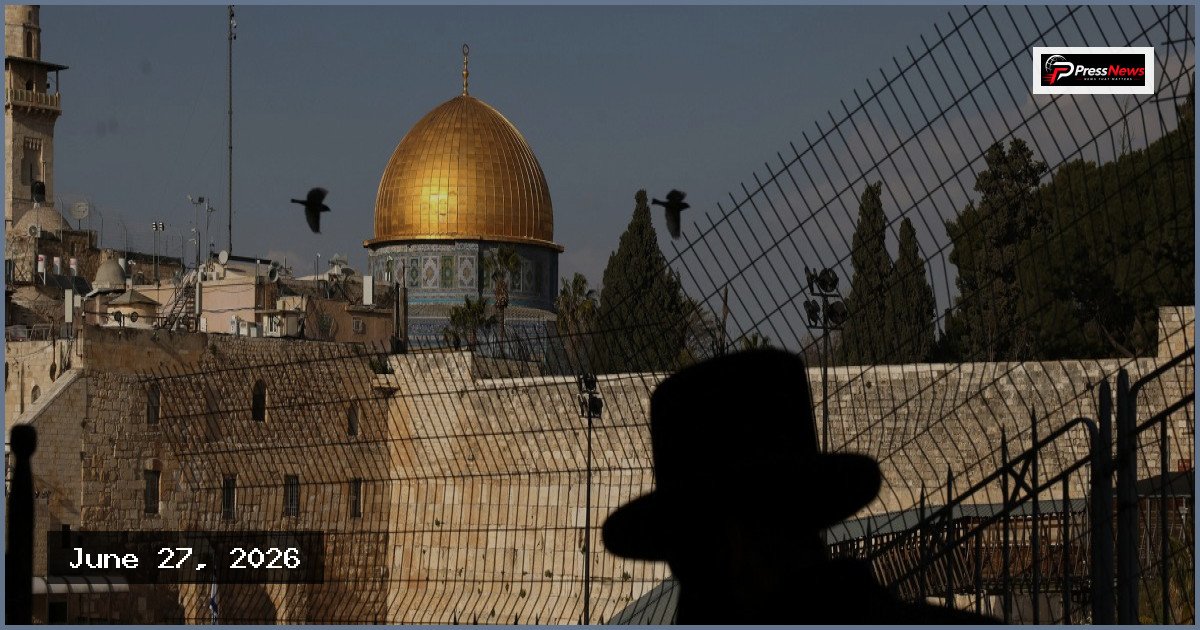
JERUSALEM — The ancient golden dome of the Al-Aqsa Mosque complex, shimmering above Jerusalem, projects an image of tranquility that sharply contrasts with the earthly struggle over who holds the right to worship at this sacred site.
A movement, once considered marginal, is now gaining significant traction within the Israeli government and among some American evangelical Christians. This movement aims to dismantle the compound’s Islamic governance, permit non-Muslims to pray there, and ultimately construct a new Jewish temple on the site. The Al-Aqsa complex has historically been a flashpoint for violence in the region.
Known as the Temple Mount movement, this loose alliance of Israeli religious and nationalist organizations combines prophetic beliefs with political aspirations. Its objective is to overturn approximately 1,300 years of Muslim stewardship over what is considered the third-holiest site in Islam and the holiest for Jews.
“Muslims are allowed to sing, unfortunately tourists are not yet allowed to sing,” U.S.-born rabbi Yehudah Glick, a prominent leader of the movement, informed NBC News during a recent tour of the compound with about 20 individuals. He added, “One of our major battles is to change that situation and to be allowed to sing and pray on the mountain.”
During the tour, Glick cited passages from sacred texts, including the Bible’s Book of Zechariah, which foretells God’s return to Jerusalem. He also encouraged his group to visualize the first and second Jewish temples, which, according to ancient Hebrew texts, once stood on the very spot.
Among those accompanying Glick were evangelical Christians, some of whom are motivated by the conviction that God promised the land of Israel to the Jewish people, who would govern it until Jesus’ return to Jerusalem for the rapture and their ascent to Heaven.
Cydney Galbraith, a Canadian designer and self-described Christian Zionist participating in Glick’s tour, expressed her belief that divine intervention would compel Muslims to leave the complex. “I think the Lord is going to do something so unusual that our minds can’t conceive,” Galbraith stated. “And we’re going to watch him push them out. He’s going to totally drive them out.”
For his part, Glick envisions a future temple as a “house of prayer for all nations,” not exclusively for Jews, Christians, or Muslims.
However, the notion of the compound becoming a shared space is at odds with the current political realities in modern Israel, according to Aviv Tatarsky, a researcher with Ir Amim, an Israeli rights group that documents conflicts in Jerusalem and advocates for all its residents. Tatarsky highlighted that most Palestinians live under occupation and East Jerusalem residents effectively lack political representation, making the idea of sharing the compound “very twisted.”
He further elaborated, “Any place that Jewish settlers, Israeli settlers, and the Israeli government put their eyes on, the thing is to expel Palestinians from it,” referencing the Israeli-occupied West Bank and evictions of Palestinian families in East Jerusalem. “To think that in the most holiest place, most contested place, things will be different is very naive.”
Such a change would likely provoke widespread anger among Palestinians, whose predominantly Muslim community has worshipped at the Al-Aqsa Mosque since its construction in the 8th century. Muslims revere the site as the place from which Prophet Muhammad ascended to Heaven from the Dome of the Rock.
A stark illustration of the issue’s volatility occurred in 2000 when then-Israeli opposition leader Ariel Sharon entered the compound, escorted by police and soldiers. This act was widely perceived as a deliberate provocation and ignited riots across Jerusalem’s Old City.
The subsequent five years of violence across Israel, the occupied West Bank, and the Gaza Strip, known as the Second, or Al-Aqsa, Intifada, were marked by frequent suicide bombings and intense military operations.
Any attempt to alter the religious status quo of the site could be perilous, warned Mazen Jabari, a Palestinian political consultant and researcher whose family history in Jerusalem’s Old City spans 600 years and who lives within sight of Al-Aqsa. “You are playing with fire when you want to change the situation inside,” he asserted, noting, “In Rome, if you go to the Vatican, you buy a ticket and you go inside. But I cannot pray inside this place.”
While Israel maintains control over security and access to the compound, the Jordan-based religious authority known as the Jerusalem Islamic Waqf administers religious affairs and grants Muslims exclusive prayer rights.
According to both the Waqf and Glick, over 70,000 Jewish activists entered the mosque compound last year, a significant increase from the 33,000 visits reported by the Waqf in 2021.
The Waqf stated to NBC News that these growing “incursions” are accompanied by increased Israeli involvement in the management of services and facilities within the mosque. “The goal is to transfer the center of administrative decision-making related to the management of Al-Aqsa Mosque from the Jordanian Waqf to the Israeli agenda,” the Waqf’s statement added.
The office of Israeli Prime Minister Benjamin Netanyahu has affirmed that there is no change in policy regarding the compound’s status quo. However, members of his government, including National Security Minister Itamar Ben-Gvir, openly disregard this policy, frequently visiting Al-Aqsa and bringing Jewish settlers to pray.
During Glick’s tour, NBC News observed a Jewish group openly violating the rules by praying and prostrating at the edge of the compound, under police protection. Later, they unfurled Israeli flags and sang the national anthem on the steps leading to the Dome of the Rock.
Jerry Bowers, a pastor from Brownwood, Texas, who was also part of Glick’s tour group, expressed his desire for increased access to Al-Aqsa for non-Muslims. “We believe as Christians that this is going to be the eternal gathering place for all Christians at the end of time, and so it’s important to pray for peace, peace for Jerusalem,” Bowers stated. He further suggested that Israel, rather than the Jerusalem Waqf, should administer the site “because there’s going to be more freedom” than “what it has been.”
Other tourist groups explored the grounds, taking selfies, while only a few Muslim worshippers were visible. Israeli authorities regularly restrict Palestinians’ access to the site.
The Temple Mount, built on the rock where many Jews, Christians, and Muslims believe God spared Abraham’s son Isaac from his father’s knife, is also the location of two previous Jewish temples. The First Temple is thought to have been constructed during King Solomon’s reign approximately 3,000 years ago and was destroyed around 587 B.C. by the Babylonians. The Second Temple was erected after a period of Jewish exile, only to be destroyed in A.D. 70 by the Romans.
According to Tatarsky, the researcher with the Ir Amim rights group, the concept of a third temple, once considered “lunatic,” is now gaining mainstream acceptance.
Religious convictions and a harsh political reality are once again reaching a boiling point at this ancient location. On this year’s Jerusalem Day, a May 14 holiday commemorating the capture of East Jerusalem by Israeli forces in 1967, far-right minister Ben-Gvir was seen waving an Israeli flag in front of the Dome of the Rock, as depicted in a video released by his office.
Ben-Gvir, who frequently marches into the compound to pray with his supporters, then quoted a paratrooper from the Israeli forces that seized Jerusalem’s Old City in 1967: “The Temple Mount is in our hands.”