
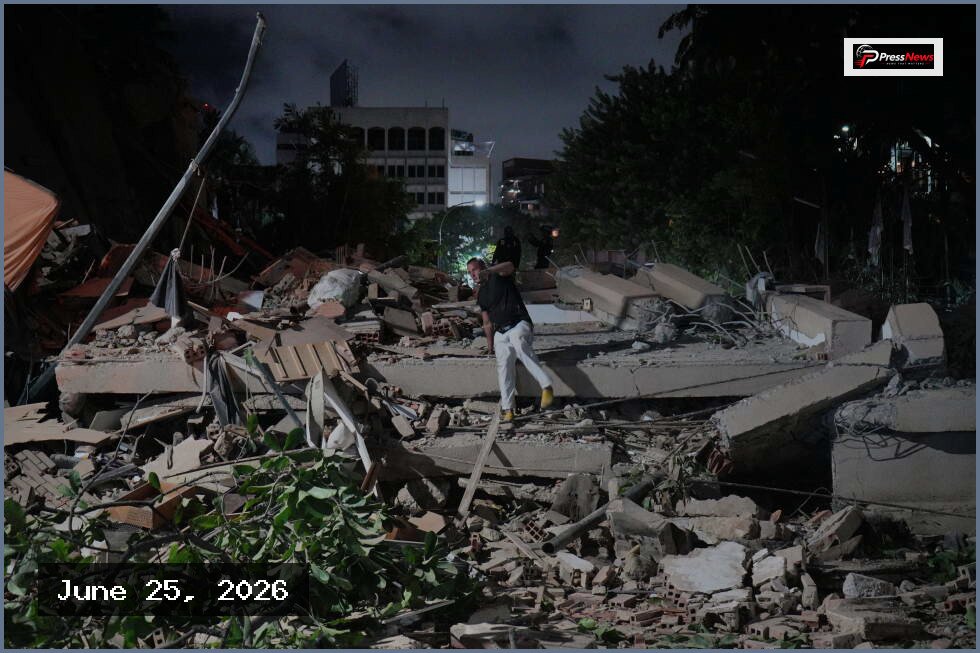
In La Guaira, Venezuela, residents on Thursday continued their desperate search for survivors amidst the wreckage of collapsed buildings, while rescue teams accelerated their efforts in northern areas severely impacted by two powerful earthquakes. Officials have confirmed that at least 188 people have died, with over 200 still trapped, and fears of more fatalities.
The 7.2- and 7.5-magnitude earthquakes, which struck on Wednesday evening, were among the most potent to hit Venezuela in over a century and were felt across the wider region. Approximately 1,500 people sustained injuries, and thousands more have been reported missing nationwide. The coastal area of La Guaira, situated north of the capital city Caracas, bore the brunt of the damage and casualties, according to authorities.
The tremors were so strong that buildings were evacuated as far away as Brazil’s Amazon, located about 1,700 kilometers (1,050 miles) from Caracas, where the country’s main airport suffered damage and was subsequently closed.
Throughout cities in northern Venezuela, panic-stricken residents spilled into the streets, with many sifting through debris in search of missing loved ones. Television broadcasts depicted rescue workers employing power tools to navigate through piles of rubble.
In La Guaira, retired schoolteacher Juan Alberto Mendaño recounted climbing through wreckage and past a deceased body when he spotted a trapped woman signaling for help with her hand.
“God, let them rescue her as quickly as possible,” Mendaño expressed. “When we heard the scream, there was nothing we could do.”
At another damaged apartment complex, residents cried out the names of those unaccounted for, shouting, “Mirna! Marquitos!”
Offers of assistance have poured in from across the globe, including from the United States, which had earlier this year seized Venezuela’s then-president Nicolas Maduro in an unexpected military operation.
This natural disaster presents the latest challenge for acting President Delcy Rodríguez, the former vice president who assumed office in January following Maduro’s capture. Venezuela has been grappling with economic turmoil for over a decade, and many citizens dispute the legitimacy of the political movement Rodríguez represents.
Jorge Rodriguez, who serves as the president of Venezuela’s National Assembly and is the acting president’s brother, provided updated figures on Thursday regarding the deceased, trapped, and injured.
Delcy Rodríguez announced that authorities were redeploying rescue teams from other parts of the country to La Guaira, which she characterized as a “disaster zone.”
“Dozens of buildings have collapsed there… and we are currently carrying out intensive rescue operations to save lives,” she stated.
Civilians and authorities worked together to pull injured children, animals, and adults, covered in dust and blood, from the concrete rubble. Some families were seen weeping in grief before their destroyed homes.
Rodríguez appealed to businesses to provide heavy construction equipment for the ongoing rescue operations, adding that search and rescue teams certified by the United Nations were en route to offer assistance.
While Venezuela is situated near multiple fault lines, its location straddling the South American and Caribbean plates means that powerful earthquakes are considerably less frequent compared to other parts of Latin America.
The U.S. Geological Survey (USGS) reported that the initial earthquake, with a magnitude of 7.2, struck west of Moron on the Caribbean coast, approximately 170 kilometers (105 miles) west of Caracas, at a depth of 22 kilometers (about 14 miles). Just one minute later, the USGS recorded a second earthquake of 7.5 magnitude, with a depth of 10 kilometers (about 6 miles) and an epicenter 16 kilometers (10 miles) southwest of Moron.
Officials cautioned the public to remain outdoors, warning that aftershocks could inflict further damage.
During the quakes, people fled from swaying buildings. Many were left stunned on Thursday morning as they observed structures reduced to skeletal remains, furniture dangling from windows, and helicopters circling overhead.
In La Guaira, Cristian Carreño gazed at his charred apartment building, which was tilting precariously to one side.
“I lost everything,” he lamented. “There are people still inside, I imagine, that couldn’t get out. It’s incredibly devastating.”
Dayana Delgado, a mother of three, expressed her desperation over her missing 8-year-old son. Delgado questioned the whereabouts of the heavy machinery promised by government officials, noting that neighbors were the ones digging through the rubble.
“I want to know where my child is, if he’s trapped or in a shelter,” she pleaded.
Authorities advised people against returning to homes with structural damage. In downtown Caracas, hundreds spent the night huddled in parks, parking lots, and other open areas.
“We were afraid the buildings would collapse on us,” said María Cristina Díaz, a 41-year-old janitor. “My mother, my daughter and I were cold. We didn’t sleep a wink.”
“It was awful. We cried, we screamed. Thankfully, we’re alive,” she added.
Parts of the capital experienced power outages and loss of cellphone service, Rodríguez confirmed. Subway services were suspended, and natural gas supply was shut off, she added. Classes will also be canceled for several days, with the Ministry of Education announcing that some school buildings would be utilized as shelters and donation centers.
Families began posting flyers with photographs of missing loved ones, while others shared handwritten lists of names as they searched for those still unaccounted for. Venezuelans residing abroad faced difficulties in contacting their relatives.
The U.N. human rights mission in Venezuela urged the government to lift local restrictions on social media platforms to ensure people have more timely access to potentially life-saving information. In August 2024, Maduro had ordered X blocked in an attempt to suppress information exchange among those who rejected his claim of victory in the July presidential elections.
Rodríguez declared a state of emergency in a national address late Wednesday. She announced that the government was establishing a $200 million reconstruction fund for hospitals and homes damaged by the earthquakes, and had instructed the economy and finance ministers to oversee this initiative.
Countries worldwide, from Qatar to Mexico, have begun dispatching aid to Venezuela. Rodríguez conveyed her gratitude for the messages of support and offers of help.
International search-and-rescue teams are anticipated to commence their arrival in earthquake-stricken Venezuela “in the coming hours,” a United Nations spokesman stated early Friday afternoon.
Secretary of State Marco Rubio, who had conversed with Rodríguez following the quake, confirmed that the United States is “immediately” deploying search and rescue teams, medical resources, and other assistance, though he acknowledged that the closure of the Caracas airport was posing some logistical challenges.
The United Nations reiterated on Thursday afternoon that international search-and-rescue teams were expected to reach Venezuela within hours.


