
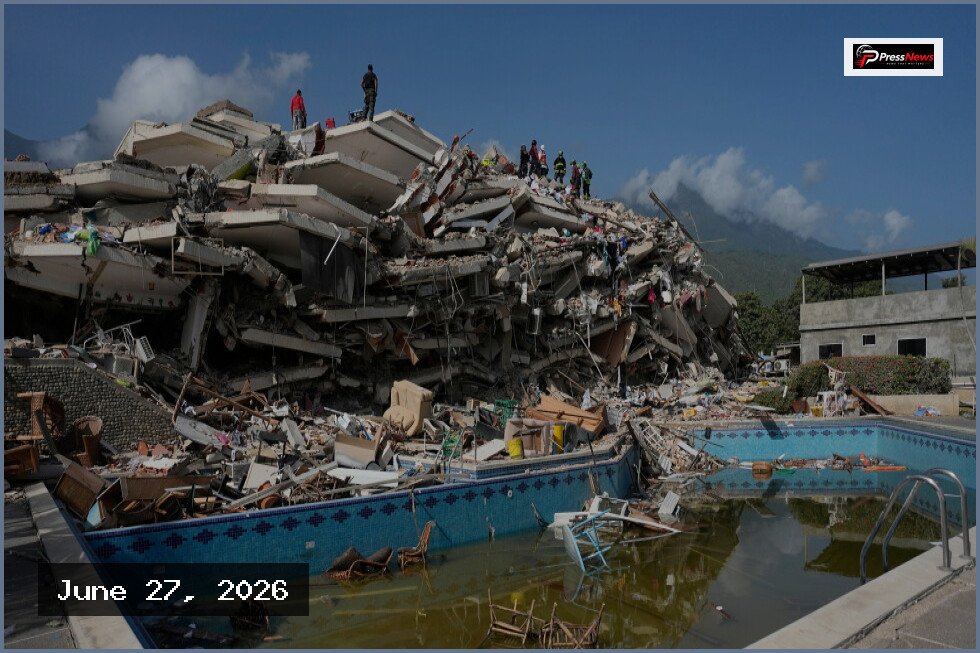
The urgency to find survivors in Venezuela has intensified as the nation grapples with the aftermath of powerful twin earthquakes, registering 7.2 and 7.5 magnitudes. Three days after the devastating tremors, people are digging through the rubble of collapsed buildings, acutely aware that time is running out to locate those still trapped.
Authorities declared Friday night that access to La Guaira, identified as the epicenter of the destruction, would be restricted. This measure aims to combat the chaos and traffic congestion that have been hindering search and rescue efforts. While officials stated that permits would be required for entry, they offered limited details on who would be granted access. Acting President Delcy Rodríguez reported on state television Saturday that over 14,000 military and police personnel are currently patrolling the affected area.
Many Venezuelans have taken it upon themselves to search for missing loved ones, expressing frustration over a perceived scarcity of government rescuers. The human toll from Wednesday’s quakes has risen to at least 920 confirmed dead, with more than 51,000 individuals reported missing. Despite official projections of a robust government response, residents in the hardest-hit regions have reported seeing few state rescue teams.
Aid organizations typically consider the initial 48 to 72 hours post-disaster to be the most critical period for rescuing survivors, though this timeframe can be extended if victims have access to essential resources like food and water.
“Every person saved is a miracle,” stated Jorge Rodríguez, president of the National Assembly. “We are not going to hide absolutely anything about the magnitude of this tragedy.”
In La Guaira, a state situated north of the capital, Caracas, Nazareth Jiménez was overcome with emotion as she watched neighbors attempt to cut through concrete slabs with hammers and power tools in a building reduced to a pile of debris. She expressed deep anxiety about the fate of her siblings, nephews, nieces, and friends, anxiously awaiting any sign of their survival.
“My God, how are we going to get them out of there?” Jiménez lamented, her voice filled with distress. “We are making a call for help to the government and countries across the world,” she pleaded, specifically requesting machinery capable of moving the collapsed structures. “There are still people alive in there.”
Government forces have been distributing food and water to survivors in La Guaira. Rodríguez affirmed that her administration is mounting a comprehensive response during these “critical hours for rescuing people alive.”
The disaster presents a significant challenge for Rodríguez, who assumed office in January following the apprehension and removal of then-President Nicolás Maduro by the United States. Venezuela has been experiencing prolonged economic hardship for over a decade, and a segment of the population questions the legitimacy of the political movement Rodríguez represents.
The death toll is anticipated to increase, and independent digital databases indicate tens of thousands of missing persons. These figures may include individuals who are unreachable due to the disruption of cellphone signals, and some reports could be duplicates.
As of midday Friday, the number of injured stood at over 3,300, with authorities reporting the rescue of 243 individuals.
The International Organization for Migration estimates that up to 6.76 million people could be affected, with approximately 2 million of them in Caracas alone. Experts attribute the amplified destruction to the rapid succession of shallow earthquakes.
Loyce Pace, the International Red Cross’ regional director for the Americas, noted that “people are still terrified to reenter what were their homes.” Consequently, many survivors continue to sleep outdoors.
Omar Reyes shared his devastating loss, stating that around 20 family members perished. “I’ve been left alone in this life,” Reyes said, walking through the ruins where two of his children were buried.
In the city of Maiquetia, residents formed lines outside stores and pharmacies, which served them individually behind closed doors. In one instance, a woman in a crowd fell to the ground, shielding a package of diapers with her body in a desperate attempt to protect it.
The presence of traffic and numerous motorcyclists at times disrupted search operations. Mexican soldiers and volunteers repeatedly requested silence to listen for signs of life beneath the rubble, but the persistent honking of horns and revving of engines by civilian and uniformed bikers frustrated the first responders.
In Catia La Mar, an area adjacent to the country’s main airport, some individuals began to take essential goods like toilet paper and food from stores. Others crowded around a civilian pickup truck distributing bread and water until a soldier intervened. The parking lot of a pharmacy was transformed into a makeshift shelter, equipped with tarps, hammocks, and tents.
A few miles away, 28-year-old Yuleidy Cadenas stood across the street from a collapsed public housing building, holding onto hope that her son, mother, and brother would be rescued alive. She recounted fleeing barefoot from another building as it crumbled on Wednesday, only to find that her mother’s 12-story apartment tower had pancaked.
“I got on top of the rubble and told them to yell back, and nobody did, not my brother, nor my son or my mother,” Cadenas said, her voice heavy with grief.
Venezuelan authorities reported on Friday that 861 volunteers from Mexico, the U.S., El Salvador, Switzerland, Colombia, and other nations were present in the country, with more expected to arrive.
Acting President Rodríguez stated that she had spoken with U.S. President Donald Trump and Secretary of State Marco Rubio on Friday. They reportedly reaffirmed their commitment to dispatching rescue teams and providing aid equipment.


