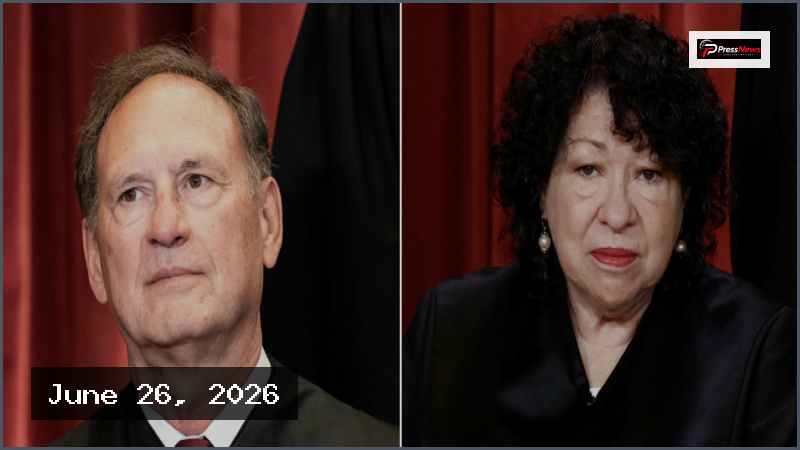
When major rulings are announced, Supreme Court justices typically maintain a practiced sense of impassivity. Regardless of their opposition to a colleague’s decision as it is delivered from the elevated bench, they usually remain stone-faced. Even when justices in the majority resent an oral dissenting statement, they generally avoid showing emotion in the courtroom. However, Justice Samuel Alito, who has a documented history of reacting with visible annoyance—including his notable eye-rolling while Justice Ruth Bader Ginsburg read an opinion in 2013—let his anger flare on Thursday toward Justice Sonia Sotomayor.
Alito indicated to those present that he had been caught off guard by her oral dissent to his majority opinion, which favored the Trump administration in a dispute concerning refugee policy at the southern border. “There’s much that I would have added to my bench statement had I known there would be a dissent read,” Alito remarked, barely masking his frustration after Sotomayor concluded her lengthy statement. While this incident departed from the court’s usual decorum, it aligned with Alito’s history of exuding a sense of aggrievement despite the prevalence of his conservative legal views. On Friday afternoon, the Supreme Court issued a statement clarifying that “Justice Alito was notified in advance by Justice Sotomayor’s chambers that she would be reading a dissent from the bench. It was a misunderstanding on Justice Alito’s part.”
Alito, currently in his 20th year on the bench, had recently faced speculation regarding a potential retirement, though sources close to him suggested he would remain for at least another session. In March, he had been hospitalized after falling ill at a dinner in Philadelphia, an event kept quiet by officials for nearly two weeks. Thursday’s proceedings began shortly after 10 a.m. ET, as the justices started announcing four of their remaining dozen cases. Initially, Justice Brett Kavanaugh delivered an opinion favoring the Monsanto Company in a failure-to-warn case, noting that federal law preempted state-level labeling requirements.
Chief Justice John Roberts then announced that Alito would deliver the court’s opinion for three cases. After a brief explanation of a Second Amendment decision regarding Hawaii handgun laws, Alito detailed the decision on refugee policy. The case centered on immigration law regarding when a person “arrives in the United States” and becomes eligible for asylum. Alito’s 6-3 opinion, signed by the six Republican-appointed conservatives, stipulated that a refugee must set foot on U.S. soil to initiate the asylum process, reversing lower court rulings. Justices Sotomayor, Elena Kagan, and Ketanji Brown Jackson dissented.
Sotomayor, who turned 72 that day, read her dissent for just over 10 minutes. She cited the 1939 case of the M.S. St. Louis, which carried some 900 Jews fleeing Nazi Germany but was turned away from the U.S., Cuba, and Canada; after returning to Europe, more than 250 of those refugees were killed in the Holocaust. She argued that post-World War II protections allow anyone at a port of entry to apply for asylum. She also criticized “metering” practices, which block people from crossing from Mexico, calling the majority’s interpretation “egregiously wrong.” Throughout the reading, Alito, 76, looked at spectators or kept his eyes closed with his hands clasped.
The courtroom does not allow cameras, though Alito’s expressions have been captured previously, such as in 2010 when he mouthed “not true” during a State of the Union address. It was only when Alito returned to the microphone to announce his next case that his frustration with Sotomayor’s oral dissent became public. He noted that administrations from both parties—including the Obama administration, which began the practice in 2016—had supported keeping people from crossing at overwhelmed ports of entry. While Alito’s written opinion spanned 18 pages compared to Sotomayor’s 35-page dissent, he did not read his written rebuttal out loud, opting instead to tell the court, “I will move on to the next case.”