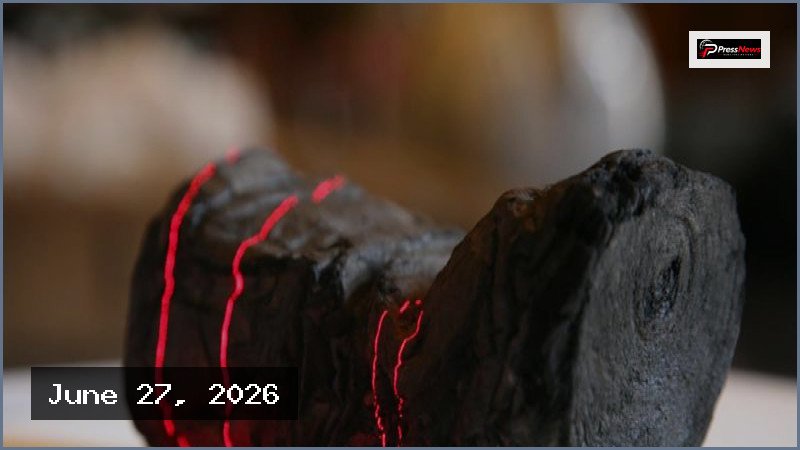
Nearly 2,000 years after Mount Vesuvius erupted and destroyed the Roman town of Herculaneum, researchers have successfully deciphered a carbonized papyrus scroll using artificial intelligence. The artifact, known as PHerc. 1667, is part of a large collection found in an 18th-century villa, believed to have belonged to the father-in-law of Julius Caesar. These fragile scrolls were scorched by volcanic debris in 79 AD, rendering them extremely delicate and difficult to study through traditional physical methods like unrolling or chemical treatment, which historically caused significant damage.
To overcome these obstacles, the Vesuvius Challenge was established in 2023 by University of Kentucky computer science professor Brent Seales, alongside entrepreneurs Nat Friedman and Daniel Gross. The initiative encourages global collaboration to virtually unwrap and decode the documents. The process begins with high-resolution CT scans of the coiled, warped papyrus. Researchers then use advanced AI models, trained to detect ink on the page, to flatten the virtual layers of the scroll.
A major milestone was announced at a conference in Naples, Italy, where scientists revealed they had successfully unwrapped one scroll, recovering almost 1.5 meters of text across 20 distinct columns. Professor Seales noted that for centuries, these texts were physically preserved but intellectually locked away; now, through interdisciplinary innovation, they can finally be read. Federica Nicolardi, a papyrologist at the University of Naples Federico II, described the breakthrough as transformational. The specific scroll, which had been labeled with a readability score of zero in the 1980s, is now legible enough to follow complex philosophical arguments.
Analysis suggests the scroll dates back to the second or third century BC, potentially making it the oldest in the collection. It is approximately 8 centimeters high and 2 centimeters in diameter, though earlier attempts to unroll it physically caused it to lose much of its original size. The content appears to be a Stoic philosophical text discussing ethics, human behavior, and the concept of “horme,” or impulse, warning against the failure to regulate one’s nature.
Additionally, the research team identified text within a different scroll, PHerc. 139, confirming it is part of the work “On Gods” by the Greek philosopher Philodemus. This finding proves that the series consisted of at least eight books, significantly expanding the known historical record. As the project evolves, the focus is shifting from imaging technology to the interpretation of these long-lost philosophical insights, marking a new chapter in the study of classical antiquity.